Every year, England's local planning authorities (LPAs) receive more than 500,000 planning applications. This data has enormous potential to speed up decision-making, improve efficiency and give government, councils and communities a clearer picture of what is being proposed and where. But right now, there is no consistent, trusted foundation of planning application data, and no reliable way to find, analyse and build digital services around it.
This is largely because applicants often enter information in different formats when they complete an application form online. Some details a local planning authority (LPA) needs can be incomplete, or hard to find or understand. Planning officers have to follow this up, which adds time to the planning application process. Each council also stores this information differently, using different software that can make it hard for stakeholders to find, compare and use this data.
Consistent data at the point of application would enable the smooth flow through to later stages and make the whole process more efficient. It would also give developers of digital tools, including artificial intelligence (AI), a reliable foundation to build services that help LPAs, applicants and communities.
A data standard sets out exactly what information must be shared and how it should be structured. It means applicants know what to provide, and LPAs can accept, process and publish it more easily. That is why today we have launched a consultation on introducing the first mandatory planning application data standard in England.
What are we proposing
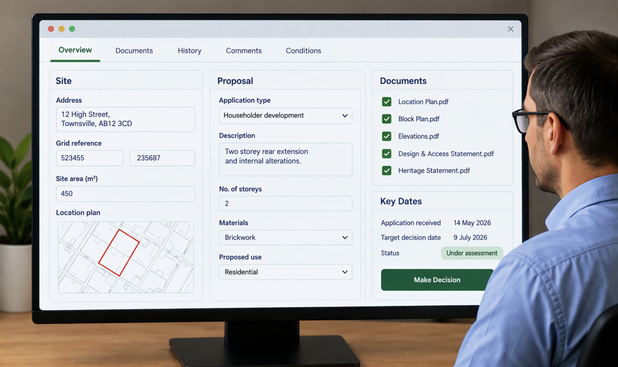
Using the planning data powers in the Levelling Up and Regeneration Act, we’re proposing regulations that will require all planning applications to be submitted and shared as consistent, structured, machine-readable data. The planning application standard will define the structure of information recorded at 2 key moments: when an application is submitted, and when a decision is reached. This will support a consistent, end-to-end data record of the planning permission process in England.
The initial planning application data standard will cover the data on the current planning application forms for the most common application types. It will also cover the data that must be published as open data from the application and decision process. Services that applicants use to submit applications will have to provide data in line with the standard. LPAs will then have to process and publish the data to the same specification.
Built collaboratively
One of the most significant aspects of this work is how we have done it. Since October 2024, we've designed the proposed planning application data standard collaboratively and in the open working with a community across government, local authorities, technology companies and established planning software providers. Members have contributed to, tested and challenged the emerging specification throughout its development. They have done this through community sessions and online forums, including GitHub (a web-based platform which facilitates collaborative development of software projects) and design.planning.gov.uk. This has been invaluable in verifying our approach and making sure the standard meets the needs of the people who use the planning system.
We have funded 5 pilot projects, through the Development Management Software Fund. These pilots have been working with each of the main back-office planning system providers used by LPAs across England to process planning applications, to test the standard in practice, help shape it and identify where more guidance is needed.
As a practical demonstration, we have developed a prototype form generator. This shows how planning application forms can be produced directly from the published data standard, demonstrating how the specification works in practice.
This collaborative, open approach is a template for how we will continue to unlock more planning data in the future. The tools and methods we have developed are repeatable, and we intend to use them as we expand the standard over time.
What this data standard means in practice
The open data published under the standard by LPAs will be compiled into a national data set on the Planning Data platform, making it easy to find, download and use. This includes access via an API (a way for other computer systems to automatically retrieve and use the data), allowing software developers, researchers and analysts to build tools and services directly from up-to-date planning data.
Once implemented the standard will:
- speed up the application process by helping to check applications are complete and valid when they are submitted
- enable LPAs to automatically report planning application metrics to central government and easily aggregate data for statistical analysis, removing a significant manual burden
- reduce the cost of building and maintaining planning software, lower barriers to market entry and encourage innovation
- enable system interoperability allowing different back-office systems to communicate seamlessly
- lay the groundwork for innovative digital services, including AI, which depend on accessible, consistent, well-structured data.
Overall, a consistent approach across the country will make submitting a planning application a more predictable and transparent process, with the potential for faster validation and processing.
Have your say
The planning application data standard represents the start of a genuine step-change in how the planning system works and we want to hear from everyone affected by these proposals. The consultation document sets out the proposals including the scope of the initial standard, the approach to secondary legislation and the implementation timeframe.
We are particularly keen to hear from LPAs, software suppliers, developers and applicants, to make sure those most affected can help shape how the standard is implemented and works in practice. The consultation closes on 30 December 2026. We will then consider all responses as we finalise the regulations and our approach to implementation.
With the right data standard in place, we can get the planning system flowing more quickly, adopt new digital tools and services and make planning data available for everyone to see and use.
For more information
Have your say in the consultation on a planning application data standard.
Read our previous MHCLG Digital blog posts about this work:
Find out more about this work and register to take part on the data standards community homepage, where you'll also find updates and relevant links. The next meeting is on 25 November 2026 at 10:30am.
For more information about the Digital Planning programme, follow us on LinkedIn to stay connected, and subscribe to our newsletter for the latest updates.



Leave a comment