
StreetLink is a national service in England and Wales that helps members of the public share concerns about someone sleeping rough so that local outreach teams can respond. It is funded by the Ministry of Housing, Communities and Local Government (MHCLG) with delivery partner Home Connections responsible for delivering the service.
Every StreetLink alert has the potential to change someone's day.
When a member of the public spots someone sleeping rough and reports this through StreetLink by submitting an alert, outreach teams rely on the information provided to locate them and offer support.
The quality of that information matters, so a detailed description of the location, such as descriptions of landmarks and distinguishing features, can significantly improve the outreach team’s success in locating the person.
An AI pilot with transformative impact
Over the past several weeks, colleagues from MHCLG’s Homelessness and Rough Sleeping Directorate have been working with Home Connections on a pilot project with 10 local authorities to explore whether AI technology could enhance the service in a practical, responsible and user-centred way.
The project was backed by MHCLG’s Local AI team, which provided funding and support, working closely with the StreetLink team as the project developed. Local AI acted as a sounding board, shared AI and product expertise, and brought learning from similar work across local government. This helped explore different approaches and shape the pilot.
The pilot had an immediate, transformative impact, halving the number of failed outreach attempts caused by poor descriptive data – dropping from 36% to 18%.
The significance of this outcome is already being recognised. Vicky Sterrett, contract manager for StreetLink in the Homelessness and Rough Sleeping Directorate, recently won the inaugural Cabinet Secretary’s AI Innovation Award for her work on the project.
In the next sections, we’ve invited Sharon Fernando from Home Connections to share the lessons and impact of the pilot. Here’s what Sharon said:
"The ambition was to explore whether AI could help people provide clearer, more useful information while keeping the process quick, intuitive and accessible.
Rather than replacing human judgement, we wanted AI to act as a supportive guide – helping members of the public include the information that outreach teams need most.
What we tested
From the outset, the priority was to ensure AI enhanced the reporting experience without adding unnecessary complexity.
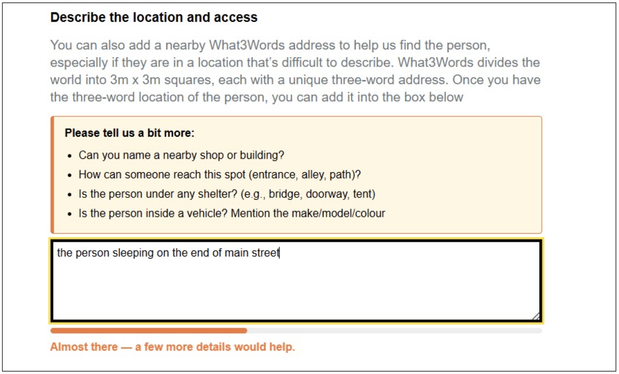
The pilot introduced intelligent guidance throughout key parts of the StreetLink reporting journey. As users completed an alert, the system offered contextual prompts to encourage more detailed location information, clearer descriptions and other practical details that could help outreach teams find someone sleeping rough.
For example, if someone entered a vague location description, the service would prompt them to add nearby landmarks, access instructions or other details that would help an outreach team find the person.
Behind the scenes, the pilot also explored how AI could assist with assessing alert quality and supporting operational prioritisation, while recognising that professional judgement from local authority outreach teams remains essential.
Working closely with local authorities
The success of the pilot has been built on collaboration.
Introducing AI into a live public service required close collaboration across operational teams, software development, analytics and customer insight. Throughout the pilot, participating local authorities played an essential role by providing regular feedback, helping us understand how the new features performed in real-world settings.
Rather than treating the pilot as a finished product, the team adopted an iterative approach by listening, learning and continuously refining the solution as new insights emerged.
Lessons learned
The pilot delivered clear improvements for StreetLink:
Better quality alerts
Users are providing richer, more detailed information, particularly when describing locations and the individuals sleeping rough. During the pilot, location descriptions increased by 45% and descriptions of individuals sleeping rough increased by 54%. This led to a significant improvement in the quality of information received by outreach teams, with 77.6% of pilot alerts rated as ‘average’ or ‘good’ under a deliberately high-quality threshold.
This is helping to create clearer, better alerts that support outreach teams in locating people effectively. This means teams can work quickly to help rough sleepers off the street.
A smoother reporting experience
The AI guidance has helped users complete alerts with greater confidence without making the reporting process more complicated. Early feedback suggests the prompts are intuitive, easy to follow and encourage users to include the details that matter most.
Nearly 89% of users said the AI guidance helped them provide more detail, and all participating local authorities supported further rollout of the functionality.
Positive operational impact
As the quality of alerts has improved, we're beginning to see good results. The proportion of people successfully found following a StreetLink alert increased from 16% to 23%, while unsuccessful outreach attempts linked to poor-quality information fell by around 50%.
Better information is helping outreach teams make more informed decisions, reducing avoidable challenges caused by incomplete referrals and increasing the likelihood of successful engagement with people sleeping rough.
Strong support from local authorities
Participating local authorities have welcomed the improvements in alert quality and have provided positive feedback throughout the pilot. Many have expressed support for a wider rollout while also helping us identify opportunities to further refine the solution.
With a wider rollout, we hope StreetLink will be able to have a greater impact in communities across the country and help rough sleepers get the support they need."
“From my experience, the AI features introduced during the pilot have made a noticeable improvement to the quality of the referrals we receive in Newport. One of the most useful additions has been the prompt encouraging people to provide a What3Words location. This has made it much easier for our team to find exact locations, particularly where there isn't a formal address or where someone is sleeping in a less obvious spot. Having that level of accuracy saves time and makes outreach visits more effective. Overall, I feel the AI pilot has improved the consistency and quality of information we receive through StreetLink. The referrals are more actionable, which ultimately helps us provide a better and more responsive service to people sleeping rough.” Isabel Young, Rough Sleeper Support Officer, Newport
Continuous learning and improvement
"Like any pilot, this project has provided valuable insight into what works well and where further development is needed. Feedback from users and local authorities is helping us refine areas such as alert prioritisation, safeguarding and AI quality scoring, ensuring the solution continues to evolve in line with operational needs. These lessons are already shaping the next phase of development and reinforcing the importance of designing AI alongside the people who use it every day."
“StreetLink exists to help people sleeping rough get support as quickly as possible. The pilot has shown that by improving the quality of information we receive, we can help outreach teams locate people more effectively and reduce missed opportunities for support. The results demonstrate that carefully designed AI can improve both the user experience and service outcomes, helping to ensure that more people receive the support they need.” Kam Basra, Deputy Chief Executive, Home Connections
What happens next
The outcomes of the pilot are clear – improvements are saving time and making the service more efficient. The full rollout is now live on the service across England and Wales.
This is particularly important as we all work together to support the Prime Minister's ambition of ensuring everyone sleeping rough has a route off the streets by Christmas.
The team will continue to work closely with local authorities, outreach providers and partners to ensure the solution fits naturally within existing workflows while continuing to improve the quality of information received through StreetLink.
As we build on the lessons from this pilot, we'll continue to ensure technology supports – not replaces – the people at the heart of StreetLink. By combining innovation with frontline expertise, we hope to make it easier for outreach teams to connect with people sleeping rough and help them access the support they need.
Recognition for the team
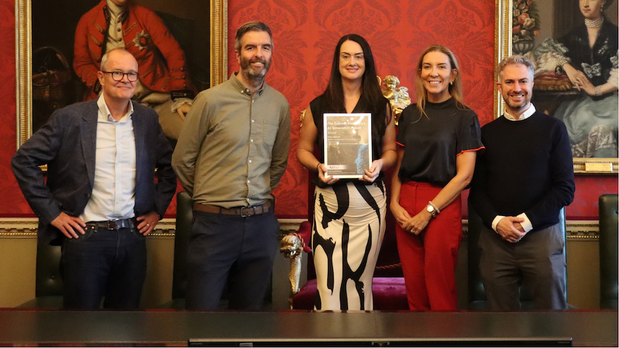
We are delighted that Vicky Sterrett, StreetLink contract manager in the Homelessness and Rough Sleeping Directorate, recently won the inaugural Cabinet Secretary’s AI Innovation Award for her important work on the pilot.
The award recognised the project’s practical impact, ingenuity and focus on using AI to make public services simpler, better and faster.
“It's easy to get excited about new technology, but for me the question is always: will this actually help people or meet the problem at hand, and will it make things easier for the teams using it? As contract manager for StreetLink, I’m pleased to see such strong evidence of the difference this pilot has made. The AI features helped users provide more detailed and useful information, resulting in better-quality alerts and improved outcomes for outreach teams. Ultimately, that means a greater chance of connecting people sleeping rough with the support they need.” Vicky Sterrett
“This project is a brilliant example of AI being used to solve a real problem and make a tangible difference. The StreetLink team and Home Connections have done a fantastic job turning innovation into practical impact, and their award is thoroughly deserved. This is exactly the kind of work we want to support through Local AI.” Sam Selmon, Head of Product, Local AI
This work has been a genuine team effort. Thank you to all colleagues across participating local authorities, Home Connections and the wider StreetLink partnership who helped design, test, improve and deliver the pilot. Their expertise and commitment have been central to its success.
To find out more about StreetLink, get in touch with patrick.duce@communities.gov.uk.
If you’re interested in the work of Local AI, read about our recent projects or contact LocalAI@communities.gov.uk.



Leave a comment