England's planning authorities hold a wealth of information that applicants, software developers and researchers use in the planning process. Decades of valuable planning information – conservation areas, Article 4 Directions, Tree Preservation Orders (TPOs) – are, however, locked in scanned PDFs, archived maps and paper documents, organised differently by each authority and largely invisible to the tools and systems that could benefit from using it.
Good planning data is foundational to everything we are trying to achieve in the Digital Planning programme. The government has committed to delivering 1.5 million new homes this Parliament and we need faster planning decisions. This is only achievable with a planning system that is faster, more transparent and data-driven.
But a faster, better-equipped planning system depends on data that is standardised, accessible and machine-readable.
That is the problem we are trying to solve with an AI-tool called Extract.
What Extract will deliver
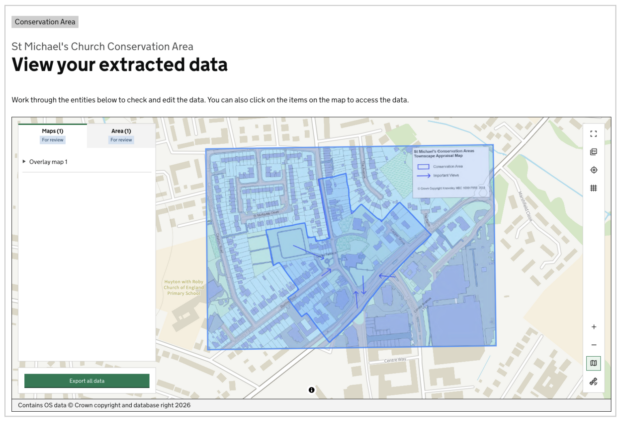
Extract is an AI-powered tool, developed by the Ministry of Housing and Local Government's (MHCLG's) Digital Planning Programme, in partnership with the Department for Science, Innovation and Technology’s Incubator for Artificial Intelligence (i.AI). It converts historic planning maps and documents into standardised, usable planning data. Tasks that currently take planning and Geographic Information System (GIS) officers hours to complete manually are being done in minutes.
For senior leaders in local planning authorities, the strategic case is straightforward. Extract will:
Reduce the data burden on planning teams
- Structuring planning records into useable, standardised data is time-consuming, technically demanding work. Extract can help with this process, freeing up officer capacity for higher-value tasks.
Improve transparency and public access
- When planning records are easy to find and understand online, applicants and members of the public can identify the right locations and policies before applications are made, reducing errors, delays and unnecessary back-and-forth.
Power the next generation of planning tools
- Consistent, machine-readable data is the building block for modern digital planning products like PlanX, BOPS and the Digital Site Register, and for the AI models that will help the planning system scale to meet housing and infrastructure demand.
Contribute to a national dataset
- The data each authority generates through Extract feeds into the national Planning Data platform, which already publishes open, standardised data from over 100 councils. Every authority that makes their data available through the platform, strengthens the shared foundation everyone can then benefit from.
The case for this is already being made – in March, the Planning Data platform saw nearly 7,000 users – our highest monthly figure since reintroducing analytics, with growing repeat usage focused on key development datasets that are essential to effective decision-making, including conservation areas, listed buildings, brownfield land and TPOs.
As a minimum viable product, Extract will support the digitisation of this data, converting existing digital documents (including scanned PDFs) into reliable, exportable data that can be integrated into geospatial analysis and digital planning tools.
What have we been doing since last summer
Following the Prime Minister’s announcement of Extract at London Tech Week in June 2025 and our last blog post explaining how the tool works, our focus has been to move from a working prototype into structured testing with real planning authorities.
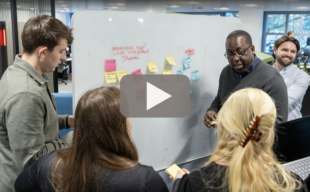
This has meant visiting councils, observing how planning and GIS teams work in practice, and iterating the product based on what we saw to improve it and make sure we have an AI-enabled service that is trustworthy and usable for planning authorities.
We’ve approached this in the same way we build other government digital services: start with the riskiest assumptions, run structured user research, and iterate based on evidence.
Simon Millier, Head of Technology and Design, Adur and Worthing Councils, said:
"We explored using the Extract AI tool to support our Tree Preservation Order plotting. We met with the product team who kindly made the visit down to Adur and Worthing's Town Hall to test the tool with our own data, giving us the opportunity to provide feedback directly to the team. It was really valuable for us to be a small part of such an innovative and exciting project. It shows real promise for substantial time-saving."
Alongside user research, we’ve continued improving the tool itself so it can be used more reliably and efficiently. The technology itself has also advanced significantly since last summer. The tool now handles complex maps more reliably, supports larger document volumes, and includes features that allow users to review, check and correct outputs against original source material - essential for building the confidence that any authority will need before using extracted data in live planning work.
What we’ve learned along the way
Turning a fast-moving AI proof of concept into a government service is not straightforward. The biggest early lesson was that real progress came when our team went into local planning authorities and worked alongside planning and GIS officers directly, understanding how data is created in practice.
Trust in outputs has been central to everything. Extract is only useful if planners are confident that what it produces meets the quality standards they would apply themselves. So we have worked at a small scale, iterating on findings, and making quality a prerequisite for any wider rollout rather than something to address later.
We have also been deliberate about what Extract is and isn't. It supports officers – it does not replace them. It helps to create standardised data faster and more efficiently - but officers review and confirm its accuracy before it is used. That verified data can then be relied upon to inform decision-making.
And alongside the visible product work, we have completed the less glamorous but essential steps any government digital service requires – an accessibility audit, terms of use, and privacy and security approvals and preparing the technical infrastructure required to operate the service on MHCLG’s systems.
So what next?
We are on track to make Extract available to all local planning authorities very soon.
To get there, we are currently conducting final testing with a small number of local planning authorities ahead of the wider rollout.
Working in the open
If you want to follow our progress as Extract develops, our weeknotes are the best place to go – here we share what we're working on, what we're learning, and what's coming next.
For more information about the Digital Planning programme, follow us on LinkedIn to stay connected, and subscribe to our newsletter for the latest updates.