To build a house, you need a sound infrastructure. There’s no point in designing a kitchen that meets all your users’ culinary needs if the plumbing’s not right.
Sustainable and reliable digital services are no different. That’s why, for the past year, the Ministry of Housing, Communities and Local Government's Funding Service has been building a new service based on an entirely new single codebase, rather than iterating on our microservices – a decision not taken lightly, as Gideon Goldberg (Lead Developer) explains in his blog post.
Having a firm footing has removed some of the constraints we were facing in working towards solving a whole problem for users. This blog post tells the story of how we got here, what we’ve achieved so far and where we’re going next.
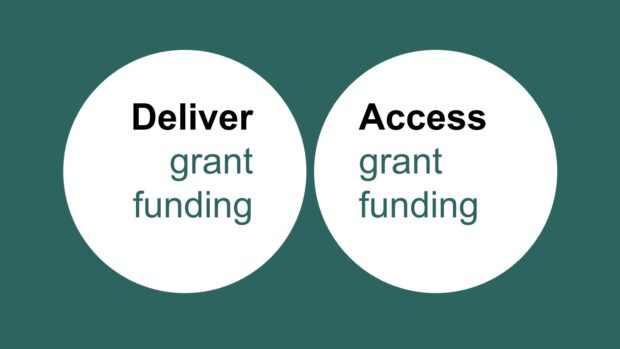
Deliver grant funding and Access grant funding – two sides of the same coin
The new service, known for a while in our team as ‘The Platform’, appears outwardly as 2 different services for different user groups, but they are inextricably linked.
Deliver grant funding – for grant teams and form builders
The service contains a way to build complex forms without developer intervention or configuration. Our content designers work with grant policy teams to co-design and build forms for monitoring reports. Grant teams can review and manage reports.
Access grant funding – for grant recipients
Grant recipients (for example, local authorities) can complete forms that have been created in Deliver grant funding. They can work though the form, using a task list and their responses are saved as they go. They submit the form so that grant teams can then access the completed reports in Deliver grant funding.
Our new service:
- provides an end-to-end experience with self-serve capability, reducing reliance on manual support
- minimises bespoke design and build by championing standardisation across journeys, patterns and components
- provides a joined-up, data-rich experience for grant teams and grant recipients
- frees up developers to focus on new features, not maintenance, by improving platform stability, reusability and operational efficiency
The service went live in December 2025 and at the time of writing, we've onboarded 2 grants: Pride in Place Impact Fund and the Common Ground Local Resilience Fund.
How we got here
Getting to this point has not always been easy, but our agile principles keep us flexible in our ways of working.
Our multidisciplinary team has had the time and space to prototype in low, medium and high fidelities, testing concepts, and quickly changing things that are not working or not meeting our users’ needs. We’ve been writing design histories to record our decisions and share our progress in playbacks and show and tells.
Starting with user needs and desk research
A lot of the groundwork was already done. Our validated user needs around grant application and grant monitoring informed the build of the new service.
And while developers learnt from the previous microservices architecture, our user-centred design team reviewed designs to take forward the ‘best bits’ which most closely aligned to our user needs and the Service Standard.
We looked across other government departments to see if other form builder solutions could meet our users’ needs. For example, we looked very closely at GOV.UK Forms and found that, while some of the core functionality suited our needs, our forms require more complex features, such as being able to reference data from other parts of a form.
With this scaffolding in place, we could start designing and developing the new service in earnest.
Working in parallel
A huge factor in the success and speed of this build was our parallel working – developers and designers working closely together. Instead of designing first and understanding technical feasibility later, we worked in parallel, sharing early ideas and pairing on prototypes. This meant that we could:
- catch edge cases designers might have otherwise not accounted for
- understand the technical dependencies and size up work accordingly
- test high-fidelity prototypes with users sooner, and with more confidence
- speed up our delivery timelines and allow for quick product decisions
Co-designing with our users
We prioritised designs on Deliver grant funding first, as that’s where forms are built, and then moved on to Access grant funding where forms are completed by grant recipients.
The 2 main user groups for Deliver grant funding are grant teams and form builders (content designers in the Funding Service). Our content designers work directly with grant teams to understand their requirements, using their expertise in structure and language to ensure each form clearly meets users’ needs. As a direct user of the form building functionality, our content designers have been instrumental in providing feedback, and we’ve been able to iterate quickly.
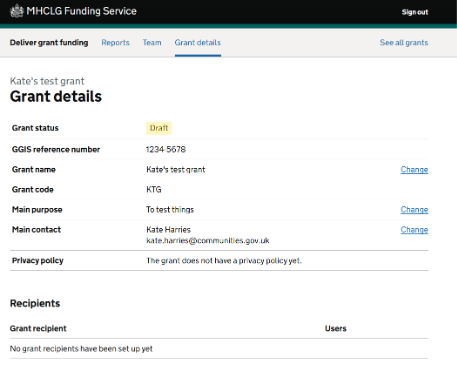
Early features designed and built on Deliver grant funding included:
- adding details about a grant
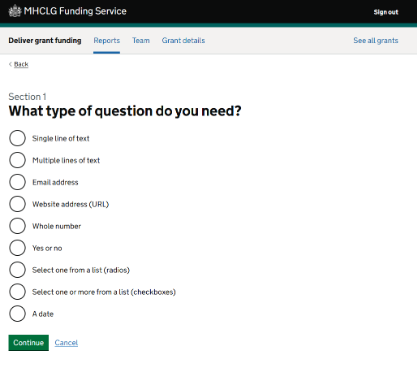
- creating a form using sections and questions
- adding different question types to a form
- previewing a form
And on Access grant funding:
- adding details about an organisation (grant recipient)
- completing a form
- submitting a form
We tested early with all user groups so we could iterate as we went.
Continuing the build
Since going live in December, we’ve been focusing on 4 main areas:
Data handling
- Support complex financial data and calculations in forms
- Enable referencing previous answers and submissions
Form management
- Give form builders the ability to publish forms themselves
- Support question copying and report duplication
- Improve language and content following user research findings
Connectivity
- Allow form builders and policy teams to manage user access
- Provide other government departments access to the service
- Refine processes to make certifier verification more robust
Compliance and accessibility
- Test with users who use assistive technology (first round completed!)
- Complete accessibility statement and publish statement
We kept the names of the services intentionally broad to give ourselves room to grow. We’re currently assessing opportunities to integrate with other services or expand Deliver grant funding and Access grant funding, depending on user need.
We’re currently working with other government departments who have similar user groups (and we’ve even hosted grants on our service, too), so get in touch by emailing fundingservice@communities.gov.uk if you'd like to find out more.
You can also read about the future direction of the service.


Leave a comment